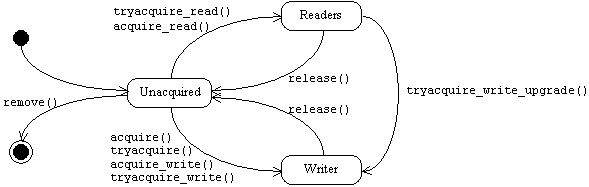
tryacquire_write_upgrade() is ambiguous at best, and outright erroneous otherwise. Second, there is no mention of the consqeunces of any non-trivial state transition.
Notes:
tryacquire_* methods.
relase() different amount of times than acquiring the lock - The ACE emulation has an internal ref_count, which is incremented each time the lock is acquired, and decremented each time release() is called. It has no way of knowing which thread is calling release(), or to validate that this thread actually acquired the lock beforehand (and did not already release it).
tryacquire_write_upgrade() without having a read lock first.
remove().
acquire_write() after acquire_read() by the same thread.
acquire_read() after acquire_write() by the same thread.
tryacquire_write_upgrade()tryacquire_write_upgrade() method's name is somewhat misleading. Although it suggests a non-blocking operation, the method sometimes blocks while trying to acquire the write upgrade. Why is that? Let’s investigate a hypothetical acquire_write_upgrade() function – a blocking method much like acquire_write(). But there is a fundemental difference between these two methods: acquire_write_upgrade() may fail, while acquire_write() can only succeed (possibly after being blocked).
This becomes clear when you think about two threads holding a read lock, that are now calling acquire_write_upgrade() concurrently: One of them should be upgraded, but only after the other one releases its read lock - since a write lock allows no readers. For that to happen, the "winning" thread should block, while the "losing" thread's request should fail without blocking, and let the "loser" politely release its read lock. If both threads block, a deadlock is created, since nothing would cause any of them to release its lock.
So the acquire_write_upgrade() method must return with a fail value at least to one of the threads. More so, it may do this immediately, as it already knows that there is yet another thread waiting for an upgrade. Therefore, this hypothetical method is actually implemented with its name preceded by try: tryacquire_write_upgrade().
Now what about the "winning" thread? It is waiting for all other read-lock holders to release() their locks, and when it is the only one left, it is promoted to an exclusive write lock, just as if it has called acquire_write(). Still, this is performed with one difference: the upgrading thread becomes an important writer - i.e., it has a higher priority than any other threads that are awaiting to acquire any lock at this point in time. This is again due to the nature of the upgrade state transition: The requesting thread must already own a read lock, so there is no theoretical possibility of giving any other thread a write lock first.
So what happens to new calls to acquire_write() or acquire_read() while there is a thread waiting for an upgrade? They will block until the upgrading thread accepts and releases its lock.
Another point worth mentioning is that the ACE rw lock mechanism was designed in such a manner that it gives preference to writers (and upgraders too). This means that threads calling acquire_read() will get their lock only after all threads that called acquire_write() and tryacquire_write_upgrade() have accepted and released their locks. (This is useful especailly when the ratio of writers/readers is small.) This is true even in the presence of an upgrading thread, although it may create an awkward situation: Thread X requests an upgrade while there are other threads owning a read lock, so it gets blocked; Another thread Y calls acquire_read() and is also blocked until thread X releases the write lock it did not yet get; All other threads call release(), which eventually yields the write upgrade to X; Then X calls release(), and Y finally gets its chance. Strange, but reasoanble.
A short summary:
tryacquire_write_upgrade() must already own a read lock.
release() their read lock to avoid deadlock.
class Owned_Thread_RW_Mutex : public ACE_RW_Thread_Mutex
{
public:
    Owned_Thread_RW_Mutex () :
        ACE_RW_Thread_Mutex (), _status (RW_LOCK_UNACQUIRED) {}
    virtual ~Owned_Thread_RW_Mutex () { this->remove (); }

    virtual int remove () {
        if (_status == RW_LOCK_REMOVED)     return -1;
        this->release ();
        _status = RW_LOCK_REMOVED;
        return ACE_RW_Thread_Mutex::remove ();
    }
    virtual int release () {
        if (_status == RW_LOCK_UNACQUIRED)  return  0;
        if (_status == RW_LOCK_REMOVED)     return -1;
        _status = RW_LOCK_UNACQUIRED;
        return ACE_RW_Thread_Mutex::release ();
    }
    virtual int acquire () { return this->acquire_write (); }
    virtual int acquire_write () {
        if (_status == RW_LOCK_WRITE)       return  0;
        if (_status != RW_LOCK_UNACQUIRED)  return -1;
        int result = ACE_RW_Thread_Mutex::acquire_write ();
        if (result == 0) _status = RW_LOCK_WRITE;
        return result;
    }
    virtual int acquire_read () {
        if (_status == RW_LOCK_READ)        return  0;
        if (_status != RW_LOCK_UNACQUIRED)  return -1;
        int result = ACE_RW_Thread_Mutex::acquire_read ();
        if (result == 0) _status = RW_LOCK_READ;
        return result;
    }
    virtual int tryacquire () { return this->tryacquire_write (); }
    virtual int tryacquire_read () {
        if (_status == RW_LOCK_READ)        return  0;
        if (_status != RW_LOCK_UNACQUIRED)  return -1;
        int result = ACE_RW_Thread_Mutex::tryacquire_read ();
        if (result == 0) _status = RW_LOCK_READ;
        return result;
    }
    virtual int tryacquire_write () {
        if (_status == RW_LOCK_WRITE)       return  0;
        if (_status != RW_LOCK_UNACQUIRED)  return -1;
        int result = ACE_RW_Thread_Mutex::tryacquire_write ();
        if (result == 0) _status = RW_LOCK_WRITE;
        return result;
    }
    virtual int tryacquire_write_upgrade () {
        if (_status == RW_LOCK_WRITE)       return  0;
        if (_status != RW_LOCK_READ)        return -1;
        int result = ACE_RW_Thread_Mutex::tryacquire_write_upgrade ();
        if (result == 0) _status = RW_LOCK_WRITE;
        else this->release ();  // auto-release to prevent deadlocks - may
                                // be inappropriate for your program.
        return result;
    }

private:
    enum
    {
        RW_LOCK_UNACQUIRED,
        RW_LOCK_READ,
        RW_LOCK_WRITE,
        RW_LOCK_REMOVED
    } _status;
};
| Comments | Mar 4, 2002 |